How the Big Bang Set the Stage for Galaxies and Life
How the Big Bang Set the Stage for Galaxies and Life
The Big Bang theory provides the foundational framework for understanding the origin and evolution of the universe. It describes how the universe began approximately 13.8 billion years ago from an extremely hot, dense state and has been expanding ever since. But beyond explaining the expansion, the Big Bang also set in motion a series of processes that led to the formation of galaxies, stars, planets, and ultimately, the conditions necessary for life. This article explores how the Big Bang laid the groundwork for the cosmic structures and life as we know it.
The Initial Conditions: Hot, Dense, and Uniform
At the very beginning, the universe was an unimaginably hot and dense plasma of fundamental particles—quarks, electrons, photons, and neutrinos—existing in a nearly uniform state. Tiny quantum fluctuations in this early plasma created slight variations in density. These small irregularities were critical; they acted as the seeds for all future structures.
Formation of Basic Elements
As the universe expanded and cooled, about three minutes after the Big Bang, protons and neutrons began to combine, forming the first atomic nuclei in a process called Big Bang nucleosynthesis. This resulted primarily in hydrogen (75%), helium (25%), and trace amounts of lithium and beryllium.
These light elements formed the raw material for everything else to come. The heavier elements, essential for planets and life, would be produced much later in stars.
From Uniformity to Structure: Gravity Takes Over
After nucleosynthesis, the universe continued to cool and expand. About 380,000 years later, it reached a temperature low enough for electrons and nuclei to combine into neutral atoms. This event, called recombination, made the universe transparent to light, releasing the Cosmic Microwave Background (CMB) radiation we detect today.
With neutral atoms formed, gravity began to dominate the growth of structures. Regions with slightly higher density due to earlier fluctuations started attracting more matter. Over millions of years, these areas grew denser, eventually collapsing to form the first stars and galaxies.
Galaxy Formation
Galaxies formed when clouds of gas and dark matter clumped together under gravity. Dark matter, an invisible form of matter, played a crucial role by creating gravitational wells that ordinary matter could fall into.
- First stars (Population III stars): Massive and short-lived, these stars synthesized heavier elements via nuclear fusion.
- Supernova explosions: These explosive deaths scattered heavy elements (carbon, oxygen, iron) into space, enriching the interstellar medium.
- Subsequent generations of stars: Formed from enriched material, they created complex elements necessary for planets and life.
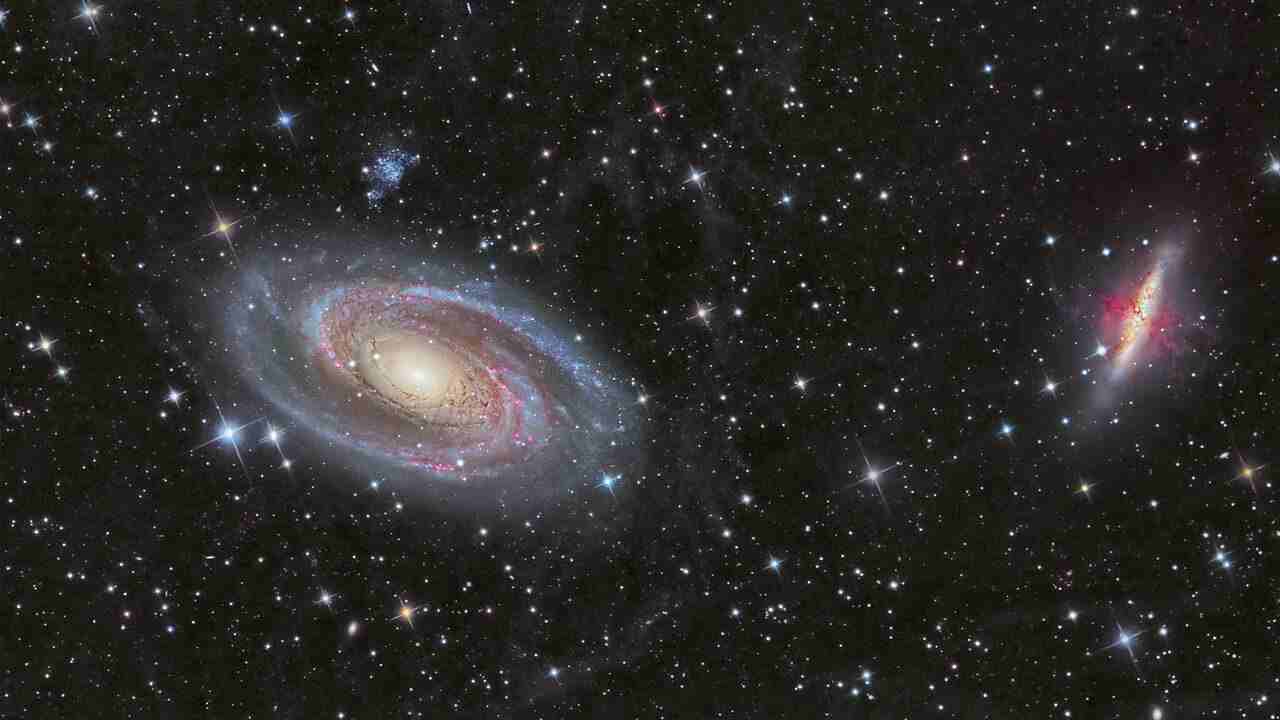
The assembly of galaxies continued through mergers and accretion, forming the diverse galaxy shapes observed today.
The Birth of Planets and Life’s Ingredients
Around some stars, dust and gas coalesced into planets. The presence of heavier elements, forged in stars, was essential for planet formation and the chemical complexity needed for life.
On Earth, this process took billions of years, involving:
- Formation of a stable planetary environment.
- Presence of liquid water, essential for biochemical reactions.
- Availability of organic molecules, building blocks of life.
Cosmic events such as comet impacts may have delivered additional organic compounds, further enriching Earth’s chemical inventory.
Why the Big Bang Matters for Life
Without the Big Bang’s initial conditions—uniformity with tiny fluctuations, nucleosynthesis of light elements, and an expanding universe where gravity could amplify density differences—none of the cosmic structures essential to life would exist.
The timeline from the Big Bang to life involves:
- Creation of matter and radiation.
- Formation of basic elements (H, He, Li).
- Recombination and CMB release.
- Gravitational collapse into stars and galaxies.
- Nucleosynthesis of heavier elements inside stars.
- Planet formation around stars.
- Emergence of life-supporting conditions.
Conclusion
The Big Bang did not just create the universe; it set the stage for a dynamic cosmic evolution that ultimately led to galaxies, stars, planets, and life itself. Through the interplay of fundamental physics, nuclear processes, and gravity, the universe evolved from a hot, uniform plasma into the richly structured cosmos we inhabit today. Understanding this progression offers deep insights into our origins and the vastness of cosmic history.
References:
- Carroll, S. From Eternity to Here: The Quest for the Ultimate Theory of Time, 2010
- Peebles, P.J.E. Principles of Physical Cosmology, 1993
- NASA Cosmic Background Explorer (COBE) mission data
- Planck Collaboration, Planck 2018 Results, 2020
- Bromm, V., & Yoshida, N., The First Galaxies, 2011
More from Big Bang & the Expanding Universe
The First Galaxies: How Did They Form After the Big Bang?
Billions of galaxies fill the modern universe, from elegant spirals to giant ellipticals stretching across hundreds of thousands of light‑years. But the very first galaxies were nothing like these enormous systems. They were tiny, turbulent, fast‑changing structures that emerged from a universe still settling after the Big Bang.
Reionization: How the First Stars Transformed the Universe
Long before galaxies took their modern shapes and long before the Milky Way existed, the universe went through one of its most dramatic transformations. It began in darkness, filled with neutral hydrogen stretching across billions of light‑years. Then the first stars appeared—brilliant, massive, short‑lived giants.
What Triggered the First Stars to Ignite in the Early Universe?
Before the first stars formed, the universe was a dark, silent expanse. There were no galaxies, no planets, and no light—only vast clouds of hydrogen and helium drifting through space. This period, known as the Cosmic Dark Ages, lasted for nearly 100 million years after the Big Bang.
Explore More Topics
Gamma-Ray Bursts: The Universe’s Most Violent Explosions
Gamma-ray bursts (GRBs) are brief, powerful flashes of high-energy radiation that outshine entire galaxies for a few seconds. They occur randomly across the sky, often billions of light-years away, yet the energy they release is so intense that Earth-based detectors can pick them up instantly. These events push astrophysics to its limits and provide a rare glimpse into the universe’s most extreme processes.
What Happens Inside a Black Hole? Exploring the Unknown Interior
Black holes are among the most mysterious objects in the universe. While scientists understand how black holes form and how they interact with their surroundings, what happens inside a black hole remains one of the greatest unsolved mysteries in physics. Crossing the event horizon—the point of no return—takes you into a realm where spacetime is warped beyond recognition and where our current theories break down.
The Darkest Objects in the Universe: How We Detect Invisible Black Holes
Black holes are famous for being invisible. They emit no light, no radiation, and no signals that can be directly detected with traditional telescopes. Yet scientists have discovered dozens of them and mapped their behavior across the cosmos. How is this possible?