Gamma-Ray Bursts: The Universe’s Most Violent Explosions
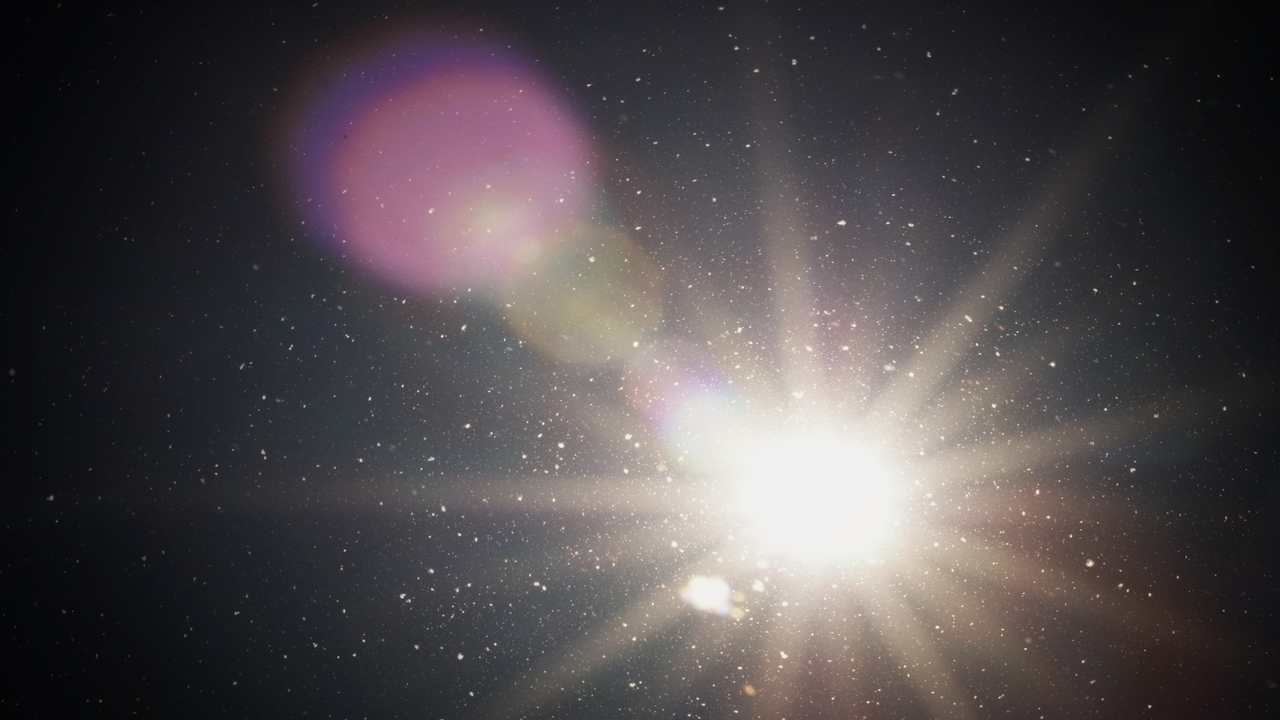
Gamma-ray bursts (GRBs) are brief, powerful flashes of high-energy radiation that outshine entire galaxies for a few seconds. They occur randomly across the sky, often billions of light-years away, yet the energy they release is so intense that Earth-based detectors can pick them up instantly. These events push astrophysics to its limits and provide a rare glimpse into the universe’s most extreme processes.
What Exactly Is a Gamma-Ray Burst?
A gamma-ray burst is a sudden, intense release of gamma radiation—the highest-energy form of light. GRBs fall into two general categories:
Short-duration bursts (less than 2 seconds)
Thought to come from:
- The merger of two neutron stars
- A neutron star merging with a black holeThese collisions release enormous energy and create a black hole in the process.
Long-duration bursts (more than 2 seconds)
Linked to:
- The collapse of massive stars
- A fast-spinning stellar core imploding into a black holeThis type is often observed alongside supernova explosions.Regardless of their origin, both types involve violent transformations of matter under extreme gravity.
How GRBs Were Discovered by Accident
GRBs were first detected in the late 1960s by U.S. military satellites designed to monitor nuclear weapons tests. Instead of finding bombs, the satellites picked up mysterious bursts of gamma radiation coming from deep space.For decades, astronomers didn’t know:
- What caused them
- How far away they were
- Why they were so powerfulOnly in the 1990s did better detectors and afterglow observations finally reveal their cosmic, not local, origins.
How Bright Are Gamma-Ray Bursts?
The raw power of a GRB is almost impossible to imagine.A single long-duration gamma-ray burst can:
- Emit more energy in one minute than our Sun emits over its entire 10-billion-year lifetime
- Outshine every star in its host galaxy
- Send radiation jets blasting across billions of kilometersThe brightness depends on the narrowness of its jet. Many GRBs are tightly focused beams, which makes them appear even more intense when pointed toward Earth.
The Structure of a GRB: Jets and Afterglows
A GRB has two main phases:
- The prompt burst – the initial flash of gamma rays
- The afterglow – longer-lasting emission across multiple wavelengths
Prompt Burst
This lasts seconds but carries most of the energy.It is formed when:
- Matter collapses inward
- Magnetic fields twist violently
- Particles are accelerated to near-light speedsThese processes launch narrow jets from the poles of the collapsing star or merging neutron stars.
Afterglow
As the jets slam into surrounding gas, they produce:
- X-rays
- Ultraviolet light
- Visible light
- Infrared
- Radio wavesAfterglows can last days, months, or even years, allowing astronomers to study GRBs long after the initial flash.
GRBs as Factories of Heavy Elements
Short GRBs—produced by neutron star mergers—play a key role in creating heavy elements. These collisions forge:
- Gold
- Platinum
- Uranium
- Rare-earth elementsThe kilonova explosion accompanying a neutron star merger spreads these elements into space, enriching future star systems.Evidence from the 2017 gravitational-wave event GW170817 confirmed that such mergers produce vast amounts of heavy metals.
Where Do GRBs Occur?
GRBs are found in:
- Star-forming galaxies
- Low-metallicity environments
- Regions with active stellar birth and deathLong GRBs often occur in young galaxies where massive stars burn quickly and explode. Short GRBs can occur in older galaxies because neutron star pairs take millions or billions of years to merge.They are truly cosmic events—occurring billions of light-years away, yet powerful enough to be detected on Earth.
Could a Gamma-Ray Burst Affect Earth?
A GRB pointed directly at Earth could damage the atmosphere, but the probability is extremely low.The nearest likely sources are too distant to pose a threat.Still, studying GRBs helps scientists understand:
- Cosmic radiation
- Planetary habitability
- Galactic environments
- Extreme astrophysical eventsEarth is largely safe, but the physics behind GRBs gives insight into how fragile atmospheres can be in hostile galaxies.
Tools Used to Study GRBs
Modern astronomy relies on a network of space-based and ground-based observatories to detect and study GRBs:
- NASA’s Swift Observatory – detects bursts and analyzes afterglows
- Fermi Gamma-ray Space Telescope – measures energy spectra
- INTEGRAL – European gamma-ray observatory
- Hubble and Webb – observe host galaxies
- LIGO/Virgo/KAGRA – detect gravitational waves from mergersThese multi-instrument observations give scientists the full picture—from the first milliseconds to the fading afterglow.
What GRBs Teach Us About the Universe
Gamma-ray bursts reveal how matter behaves under the strongest gravitational forces. They allow scientists to probe:
- The birth of black holes
- The behavior of matter at nuclear densities
- Magnetic fields stronger than anything on Earth
- The early universe, since many GRBs come from ancient galaxiesSome GRBs originate so far away that their light began its journey when the universe was only a few hundred million years old. They act as cosmic time capsules.
References
- Gehrels, N. (2013). Gamma-Ray Bursts in the Swift Era.
- Fermi Gamma-ray Space Telescope – GRB Catalog
- Berger, E. (2014). Short Gamma-Ray Bursts. Annual Review of Astronomy and Astrophysics.
- NASA Goddard Space Flight Center – GRB Educational Resources
- LIGO/Virgo Collaborations – Neutron Star Merger Observations
More from Black Holes & Extreme Phenomena
What Happens Inside a Black Hole? Exploring the Unknown Interior
Black holes are among the most mysterious objects in the universe. While scientists understand how black holes form and how they interact with their surroundings, what happens inside a black hole remains one of the greatest unsolved mysteries in physics. Crossing the event horizon—the point of no return—takes you into a realm where spacetime is warped beyond recognition and where our current theories break down.
The Darkest Objects in the Universe: How We Detect Invisible Black Holes
Black holes are famous for being invisible. They emit no light, no radiation, and no signals that can be directly detected with traditional telescopes. Yet scientists have discovered dozens of them and mapped their behavior across the cosmos. How is this possible?

Spaghettification: The Strange Physics of Being Stretched in Space
Black holes are famous for their extreme gravitational pull, but one of the strangest and least intuitive effects they create is spaghettification—a real physical process where objects are stretched into long, thin strands as they fall toward a black hole.
Explore More Topics
Are Smart Telescopes Worth It? A Beginner Buying Guide for 2026
This is why convenience can change the economics of ownership.

The Moon’s Origin: How Earth Got Its Only Natural Satellite
Earth’s Moon is so familiar and constant that it’s easy to forget just how strange its existence is. Compared with other moons in the solar system, it is enormous relative to its parent planet, unusually dense, and positioned in a way that profoundly affects Earth’s tides, climate stability, and even the evolution of life.
Why Mercury Has Extreme Temperatures: A Planet of Extremes
Mercury looks like a simple world at first glance—small, rocky, and covered in craters. But beneath that quiet appearance lies one of the most extreme environments in the solar system. Its temperature swings from scorching heat to freezing cold, making Mercury a planet of brutal contrasts unlike anywhere else.