Black Hole Mergers and Gravitational Waves Explained
Black Hole Mergers and Gravitational Waves Explained
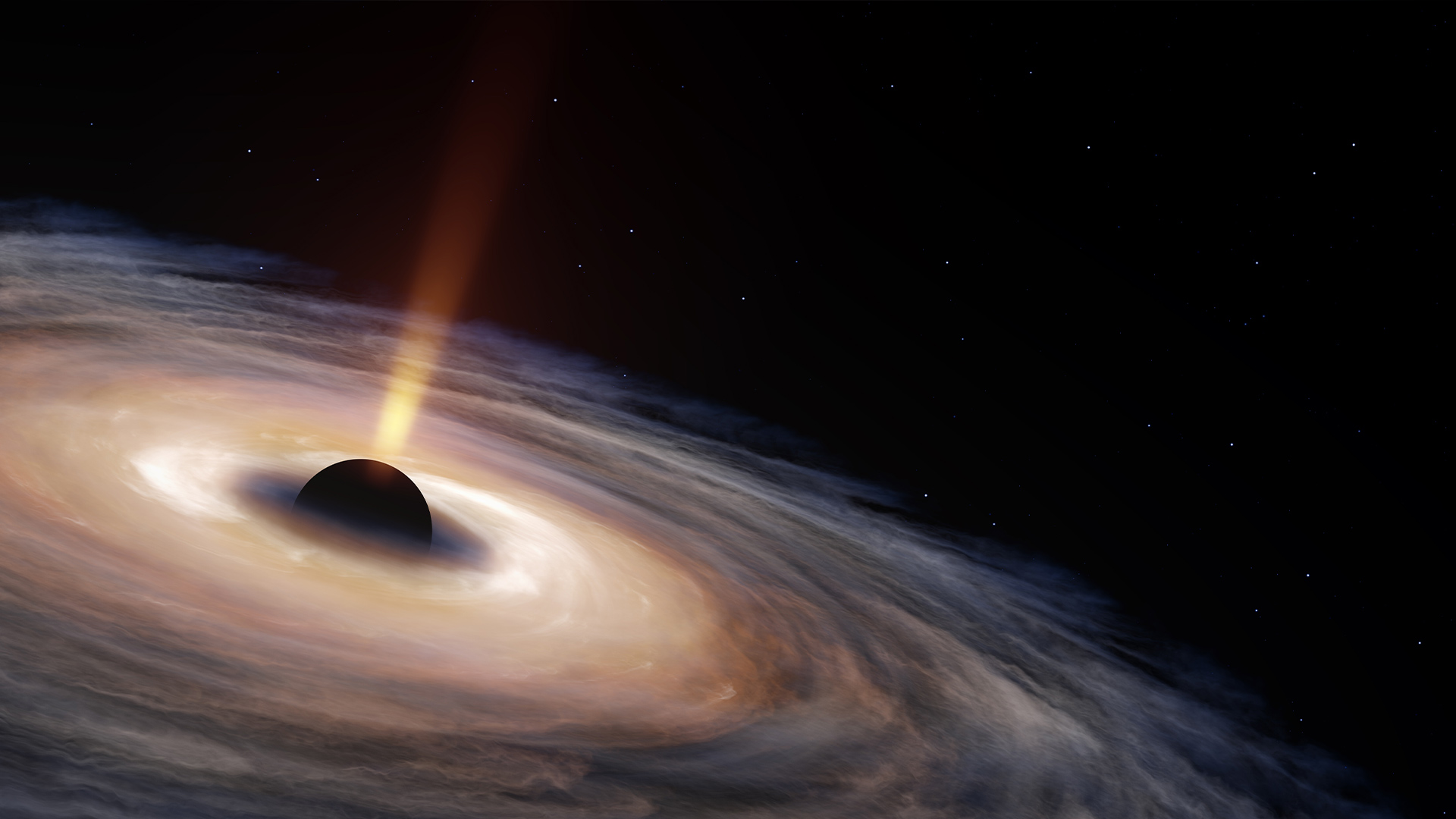
Black holes are among the most extreme entities in the universe. When two black holes collide and merge, they create one of the most violent events in space — a black hole merger. This cataclysmic interaction not only reshapes local spacetime but also generates gravitational waves, ripples that travel across the cosmos. These waves have transformed our understanding of the universe since their first detection in 2015.
1. What Are Black Hole Mergers?
A black hole merger occurs when two black holes orbit each other closely and eventually collide, forming a larger black hole. These events are driven by gravity:
- Binary black holes form from the collapse of massive stars.
- Over time, they lose energy through gravitational radiation.
- As their orbit shrinks, they spiral inward and eventually merge.
This entire process emits an enormous amount of energy in the form of gravitational waves.
2. What Are Gravitational Waves?
Gravitational waves are distortions in spacetime predicted by Albert Einstein’s general theory of relativity in 1916. They’re similar to ripples in a pond caused by a thrown stone, except they travel through the fabric of space itself.
When massive objects like black holes accelerate — especially during mergers — they send out these waves at the speed of light.
Gravitational waves:
- Carry information about their origins
- Travel unimpeded through matter
- Stretch and compress space in perpendicular directions
3. How Were Gravitational Waves First Detected?
The first direct detection occurred on September 14, 2015, by the Laser Interferometer Gravitational-Wave Observatory (LIGO). This event, named GW150914, came from the merger of two black holes:
- Masses: 36 and 29 solar masses
- Final black hole: 62 solar masses
- 3 solar masses worth of energy radiated as gravitational waves
This confirmed a century-old prediction and opened a new era of astronomy.
4. The Stages of a Black Hole Merger
A typical black hole merger has three stages:
a. Inspiral
Two black holes orbit each other, emitting gravitational radiation. This causes their orbit to shrink.
b. Merger
At close range, they accelerate dramatically and coalesce into a single black hole. This stage emits the strongest gravitational waves.
c. Ringdown
The newly formed black hole is unstable and "rings" like a struck bell, radiating final waves before settling into a stable state.
5. Why These Mergers Matter
Black hole mergers provide insights into:
- Strong gravity: They allow us to test general relativity in extreme conditions.
- Cosmic history: Gravitational wave detections help trace how black holes evolve over time.
- Stellar populations: Mergers give clues about how massive stars form and die.
- Dark matter theories: Some theories suggest primordial black holes — born shortly after the Big Bang — might merge and be detectable.
6. How Do We Detect Gravitational Waves?
Gravitational waves are incredibly subtle — they stretch space by less than the width of a proton. To detect them:
- LIGO (USA) and Virgo (Europe) use laser interferometers.
- These instruments shoot lasers down long vacuum arms (up to 4 km).
- When a wave passes, it changes the distance between mirrors at the ends of the arms.
- The interference pattern of the returning light reveals a wave’s presence.
LIGO's sensitivity allows it to detect black hole mergers billions of light-years away.
7. Notable Observations Since 2015
Since the first detection, dozens of mergers have been observed. Some notable examples:
- GW170104: A 50-solar-mass merger from 3 billion light-years away.
- GW190521: One of the most massive mergers detected, producing a black hole of ~142 solar masses — an intermediate-mass black hole, a rare category.
- GW170814: The first event observed by both LIGO and Virgo, providing improved location accuracy.
These events help build a catalog of black hole properties.
8. The Future of Gravitational Wave Astronomy
With more advanced detectors coming online, the future is bright:
- LIGO-India and KAGRA (Japan) will join the network.
- The LISA mission (space-based interferometer by ESA and NASA) is planned for the 2030s, aiming to detect low-frequency waves from supermassive black hole mergers.
- Multimessenger astronomy will combine gravitational wave data with light (e.g., gamma rays, X-rays) for richer insights.
9. Conclusion
Black hole mergers and the gravitational waves they generate have revolutionized astrophysics. These cosmic collisions offer a new way to observe the universe — not through light, but through the very vibrations of space itself. As detection capabilities improve, we’re poised to uncover deeper secrets about black holes, gravity, and the evolution of the cosmos.
References
- Abbott, B. P., et al. (2016). Observation of Gravitational Waves from a Binary Black Hole Merger. Physical Review Letters.
- Einstein, A. (1916). The Foundation of the General Theory of Relativity.
- LIGO Scientific Collaboration. https://www.ligo.caltech.edu
- Virgo Collaboration. https://www.virgo-gw.eu
More from Black Holes & Extreme Phenomena
Gamma-Ray Bursts: The Universe’s Most Violent Explosions
Gamma-ray bursts (GRBs) are brief, powerful flashes of high-energy radiation that outshine entire galaxies for a few seconds. They occur randomly across the sky, often billions of light-years away, yet the energy they release is so intense that Earth-based detectors can pick them up instantly. These events push astrophysics to its limits and provide a rare glimpse into the universe’s most extreme processes.
What Happens Inside a Black Hole? Exploring the Unknown Interior
Black holes are among the most mysterious objects in the universe. While scientists understand how black holes form and how they interact with their surroundings, what happens inside a black hole remains one of the greatest unsolved mysteries in physics. Crossing the event horizon—the point of no return—takes you into a realm where spacetime is warped beyond recognition and where our current theories break down.
The Darkest Objects in the Universe: How We Detect Invisible Black Holes
Black holes are famous for being invisible. They emit no light, no radiation, and no signals that can be directly detected with traditional telescopes. Yet scientists have discovered dozens of them and mapped their behavior across the cosmos. How is this possible?
Explore More Topics
Are Smart Telescopes Worth It? A Beginner Buying Guide for 2026
This is why convenience can change the economics of ownership.

The Moon’s Origin: How Earth Got Its Only Natural Satellite
Earth’s Moon is so familiar and constant that it’s easy to forget just how strange its existence is. Compared with other moons in the solar system, it is enormous relative to its parent planet, unusually dense, and positioned in a way that profoundly affects Earth’s tides, climate stability, and even the evolution of life.
Why Mercury Has Extreme Temperatures: A Planet of Extremes
Mercury looks like a simple world at first glance—small, rocky, and covered in craters. But beneath that quiet appearance lies one of the most extreme environments in the solar system. Its temperature swings from scorching heat to freezing cold, making Mercury a planet of brutal contrasts unlike anywhere else.