Why Pluto Is No Longer a Planet: The Real Reason

Why Pluto Is No Longer a Planet: The Real Reason
For over 75 years, Pluto was considered the ninth planet of our solar system. Discovered in 1930 by American astronomer Clyde Tombaugh, Pluto held a special place in textbooks, science museums, and popular culture. But in 2006, the International Astronomical Union (IAU) reclassified Pluto as a “dwarf planet,” triggering a wave of public confusion and debate.
So what really happened? Why was Pluto stripped of its planetary status? Here’s the real, science-based explanation.
The Discovery of Pluto
Pluto was discovered in 1930 at Lowell Observatory in Arizona. Tombaugh was searching for a mysterious “Planet X” believed to be influencing the orbits of Neptune and Uranus. Although Pluto was found, it turned out to be much smaller than expected—about 2,376 kilometers (1,476 miles) in diameter, only 18% the size of Earth and even smaller than Earth’s Moon.
Despite its small size, Pluto was accepted as the ninth planet. But this classification started to be questioned toward the end of the 20th century.
Trouble Begins: Discovery of the Kuiper Belt
In the 1990s, astronomers began discovering many icy bodies beyond Neptune in a region now known as the Kuiper Belt. These trans-Neptunian objects (TNOs) share similar characteristics with Pluto—eccentric orbits, icy compositions, and small sizes.
The turning point came in 2005, when astronomers discovered Eris, a TNO that was roughly the same size as Pluto and even more massive. If Pluto were a planet, shouldn’t Eris be one too?
This discovery forced astronomers to rethink what it means to be a planet.
The IAU Definition of a Planet (2006)
In August 2006, the International Astronomical Union introduced an official definition of a planet. According to the IAU, a celestial body must meet three criteria to be considered a planet:
- It must orbit the Sun.
- It must be spherical in shape due to its own gravity.
- It must have “cleared the neighborhood” around its orbit.
Pluto satisfies the first two conditions—it orbits the Sun and is roughly spherical. However, it fails the third requirement.
What Does “Cleared the Neighborhood” Mean?
To “clear its neighborhood,” a planet must be gravitationally dominant. This means it should have either absorbed or flung away smaller bodies near its orbit over time.
Pluto, however, shares its orbital zone with many other Kuiper Belt objects. It has not cleared its neighborhood, which disqualifies it as a full-fledged planet.
This is why Pluto was reclassified as a dwarf planet—a category for objects that meet the first two criteria but not the third.
Dwarf Planet vs. Planet: Key Differences
| Feature | Planet | Dwarf Planet |
|---|---|---|
| Orbits the Sun | Yes | Yes |
| Nearly round shape | Yes | Yes |
| Clears its orbital zone | Yes | No |
| Example | Earth, Jupiter | Pluto, Eris, Ceres |
Dwarf planets are still important celestial bodies, but they are not part of the main planetary family.
The Public Reaction and Scientific Debate
The reclassification of Pluto sparked a wide range of reactions:
- Public disappointment: Many felt an emotional connection to Pluto, especially in the U.S., where it was discovered.
- Scientific divide: Some astronomers disagreed with the IAU’s criteria and argued that Pluto should still be considered a planet.
Notably, Alan Stern, the principal investigator of NASA’s New Horizons mission to Pluto, has been one of the most vocal opponents of the redefinition.
Pluto’s Legacy and Importance
Even though Pluto is no longer officially a planet, it remains a fascinating and scientifically valuable object. In 2015, NASA’s New Horizons spacecraft flew by Pluto, capturing detailed images and data that revealed:
- Vast plains of nitrogen ice (e.g., Sputnik Planitia)
- Mountains made of water ice
- Possible subsurface ocean
- Thin atmosphere with layers of haze
These findings show that even small worlds can be geologically and atmospherically active.
Conclusion
Pluto’s “demotion” was not arbitrary—it was the result of a clearer and more consistent definition of what constitutes a planet. While no longer a planet by current standards, Pluto remains an important piece of our solar system’s story and continues to inspire both scientists and the public.
Science evolves as we gather more data and improve our understanding of the universe. Pluto’s journey from planet to dwarf planet reflects that growth—and proves that even small worlds can have a big impact.
More from Solar System Basics

Are Smart Telescopes Worth It? A Beginner Buying Guide for 2026
This is why convenience can change the economics of ownership.

The Moon’s Origin: How Earth Got Its Only Natural Satellite
Earth’s Moon is so familiar and constant that it’s easy to forget just how strange its existence is. Compared with other moons in the solar system, it is enormous relative to its parent planet, unusually dense, and positioned in a way that profoundly affects Earth’s tides, climate stability, and even the evolution of life.
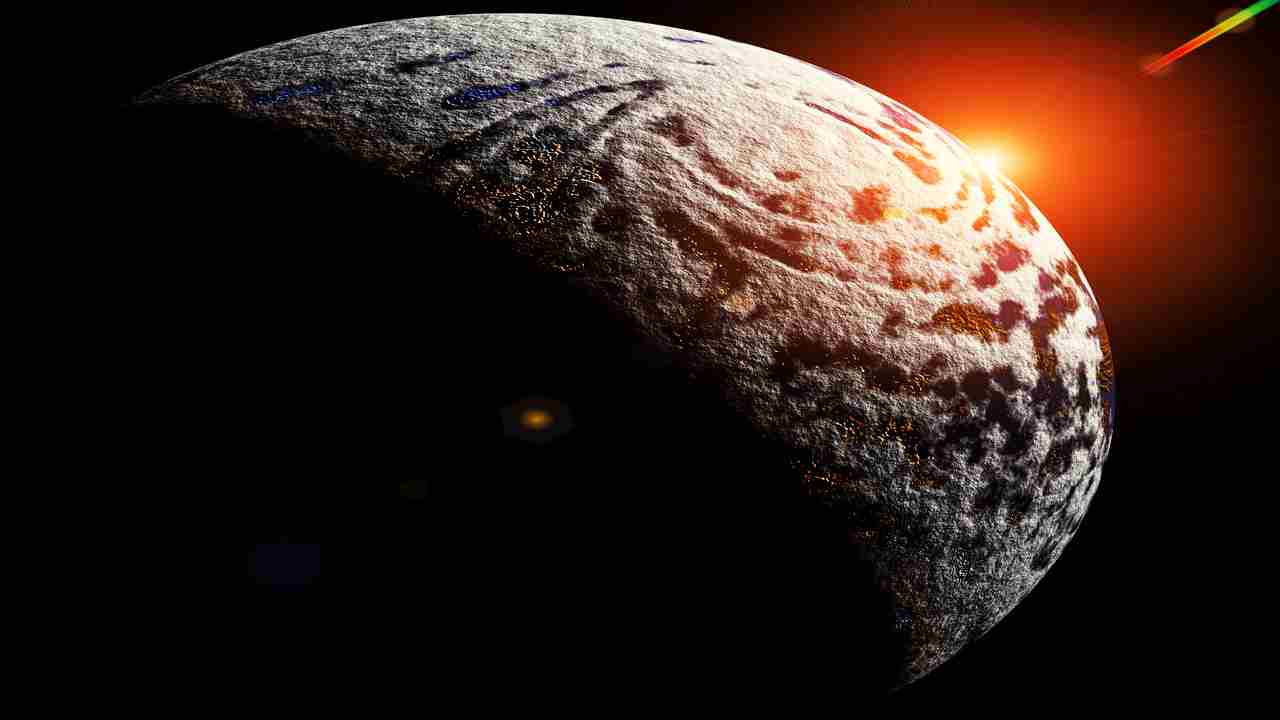
Why Mercury Has Extreme Temperatures: A Planet of Extremes
Mercury looks like a simple world at first glance—small, rocky, and covered in craters. But beneath that quiet appearance lies one of the most extreme environments in the solar system. Its temperature swings from scorching heat to freezing cold, making Mercury a planet of brutal contrasts unlike anywhere else.
Explore More Topics
Gamma-Ray Bursts: The Universe’s Most Violent Explosions
Gamma-ray bursts (GRBs) are brief, powerful flashes of high-energy radiation that outshine entire galaxies for a few seconds. They occur randomly across the sky, often billions of light-years away, yet the energy they release is so intense that Earth-based detectors can pick them up instantly. These events push astrophysics to its limits and provide a rare glimpse into the universe’s most extreme processes.

What Happens Inside a Black Hole? Exploring the Unknown Interior
Black holes are among the most mysterious objects in the universe. While scientists understand how black holes form and how they interact with their surroundings, what happens inside a black hole remains one of the greatest unsolved mysteries in physics. Crossing the event horizon—the point of no return—takes you into a realm where spacetime is warped beyond recognition and where our current theories break down.
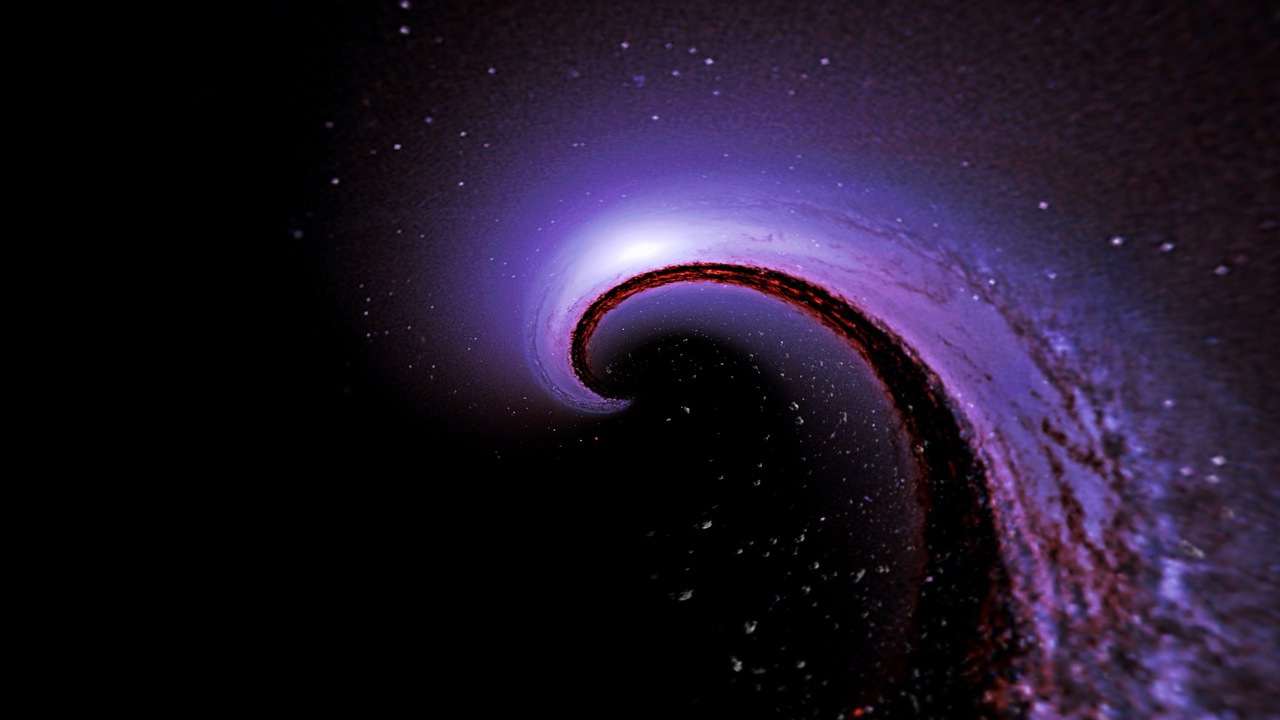
The Darkest Objects in the Universe: How We Detect Invisible Black Holes
Black holes are famous for being invisible. They emit no light, no radiation, and no signals that can be directly detected with traditional telescopes. Yet scientists have discovered dozens of them and mapped their behavior across the cosmos. How is this possible?